Introduction
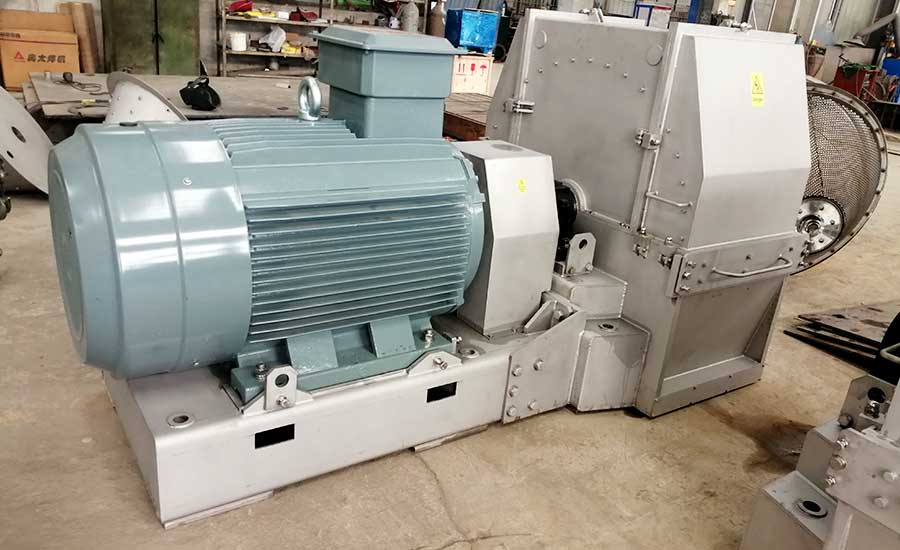
The cassava rasper is the core crushing unit in any modern cassava starch processing line, also known as cassava grinding machine. Its primary function is to rupture the raw material structure, crush peeled cassava roots into uniform pulp, and release starch granules from the cellular tissue with a high starch dissociation rate. The efficiency of this single machine directly determines the overall starch extraction rate of your entire plant.
Equipment Function: Cassava tubers are large, dense, and structurally tough, making them resistant to primary crushing. The rasper grinder performs intensive secondary filing and crushing, repeatedly grinding the tubers through a high-speed saw-blade assembly. This mechanical action disintegrates the fibrous matrix so that even microscopic starch granules are fully liberated and separated, thereby maximizing starch recovery and minimizing waste in the residue stream.
Scope of Application: Sweet potato, cassava, potato, and other starch production enterprises.
Production Capacity & Line Integration: Our rasper machines are engineered for scalability, with standard models handling 5 TPD to 500 TPD (tons per day) of fresh cassava roots. Whether you require a standalone crushing unit for an existing facility or a fully integrated module within a complete turnkey cassava starch processing line (covering washing, peeling, crushing, separation, refining, and drying), the equipment can be customized to your specific throughput. This makes it suitable for small-scale community processors, medium-sized commercial plants, and large industrial starch production enterprises alike.
Rasper Machine Working Principle
Starch in cassava and potato tubers is concentrated in the fleshy root tissue. Because raw tuber particles are relatively large and the internal cellular structure is resilient, conventional crushing often leaves significant starch trapped in intact cell walls.
The rasper machine overcomes this through repeated high-speed filing. As the tubers enter the machine casing through the upper feed inlet, they are subjected to intense impact, shearing, and grinding by the rapidly rotating saw-blade rotor. This multi-stage mechanical action thoroughly destroys the tissue structure, allowing tiny starch particles to be smoothly released from the cell matrix.
A precision screen is mounted at the lower section of the rotor chamber. Crushed material that meets the required particle size passes through the sieve apertures and is discharged as uniform slurry. Oversized fibrous particles that cannot pass through the screen are retained on the sieve plate, where they continue to be struck and reground by the circulating blades until they reach the target fineness. This closed-loop grinding action ensures consistent slurry quality and maximizes starch liberation before final discharge.
Rasper Machine Advantages
Crushing Peeled Cassava (Tapioca) Roots into Slurry
The machine is purpose-built to convert peeled cassava (tapioca) roots into smooth, homogeneous slurry while simultaneously separating coarse fibrous residues. All crushing drums, rotors, internal housings, and food-contact surfaces are fabricated from food-grade stainless steel (SS304/SS316L), ensuring full compliance with international food safety standards, corrosion resistance, and zero contamination of the final starch product.
Cassava (Tapioca) Slurry and Residues Separation
The integrated filtration zone performs continuous physical separation of fine cassava residues from the starch slurry. Oversized fibrous particles are mechanically blocked by the precision lattice screen structure, while the fluid starch slurry and fine particles pass through to become filtrate. This pre-separation step reduces the load on downstream extraction and refining equipment, protects subsequent process stages from damage caused by coarse debris, and ensures a higher-quality feed stream for centrifugal separators or hydrocyclone units.
Additional Operational Advantages:
-
High Extraction Efficiency: Optimized blade geometry and rotor speed achieve starch dissociation rates exceeding 95%, significantly improving overall plant yield.
-
Heavy-Duty Construction: Reinforced bearing assemblies and rigid frame design support 24/7 continuous operation in industrial environments.
-
Flexible Configuration: Interchangeable screen mesh sizes allow fine-tuning for different raw materials (cassava, sweet potato, potato, yam) and different downstream process requirements.
-
Energy-Optimized Drive: High-torque motor transmission delivers maximum grinding force with controlled power consumption relative to output capacity.
-
Easy Maintenance: Quick-access casing and tool-free blade replacement systems minimize downtime during routine servicing.
Integration in Complete Starch Processing Lines
As a critical front-end unit, the rasper machine is typically positioned immediately after the washing/peeling section in a standard cassava starch production line. Its output slurry feeds directly into separation equipment (such as centrifuge sieves or decanters), followed by refining, dewatering, and flash drying systems. When configured as part of a turnkey project, the rasper’s capacity is precisely matched to the upstream feeding rate and downstream processing volume, ensuring balanced line efficiency from raw material intake to final packaged starch.
Inquiry Note: To recommend the correct rasper model and corresponding line configuration, please specify your daily processing capacity (TPD), raw material type, and whether you need a single machine or a complete production line.